
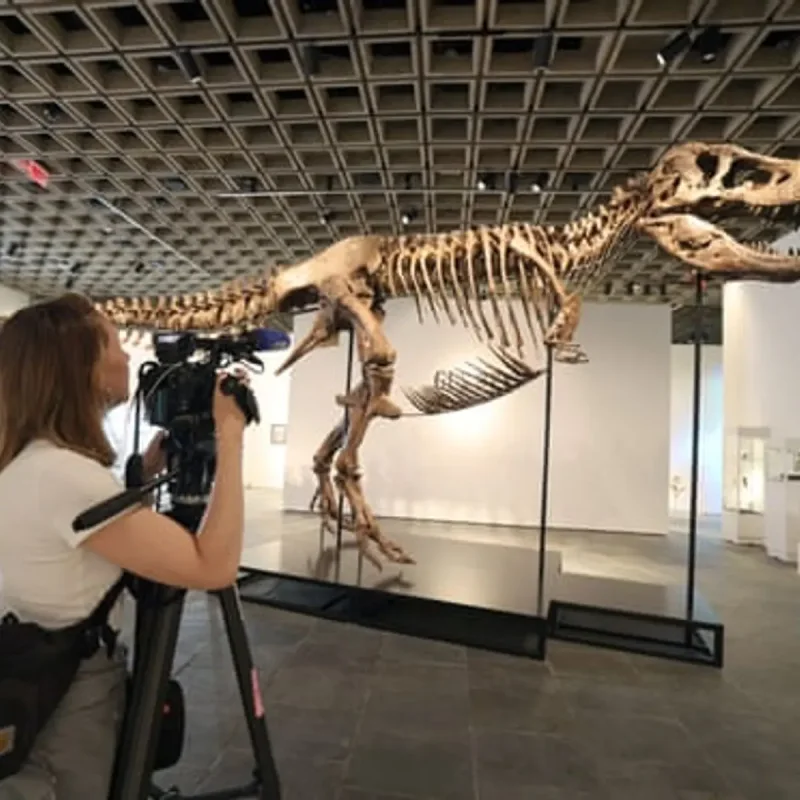
Prof Stephen Brusatte from the University of Edinburgh noted that while the American sale is legal under local property laws, it remains worrisome.
"If a dinosaur like this fetches tens of millions of dollars at auction, then there's little that scientists or museums or universities can do.
Those prices can only be paid by the super-rich," he said.
>>> Remembering Sam: Friends and Colleagues Share Heartfelt Tributes
The trend contrasts with the 1997 auction of "Sue," a T. rex purchased for $8 million by Chicago's Field Museum via public and corporate backing.
Today, high-profile celebrities and wealthy individuals increasingly view fossil collection as a private hobby.
University of Bristol professor Michael Benton suggested some buyers generate public good by loaning acquisitions to museums.
Billionaire Ken Griffin previously followed this model by loaning the Apex specimen to the American Natural History Museum for four years.
However, Carthage College associate professor Dr. Thomas Carr emphasized that short-term museum loans do not secure scientific advancement.
"A private collection has no guarantee that a fossil will stay in a collection for all time, whereas a public trust's mission is to maintain, conserve and curate its collection indefinitely," he said.
"Fossils need to be available to test previous observations and to make new insights; the fossils are the data so they must always be available for study."
Carr also pointed out that private owners retain the right to recall fossils at any moment, breaking the scientific principle of replicability.
Many scientific journals now require research papers to rely solely on fossils kept in permanent public repositories.