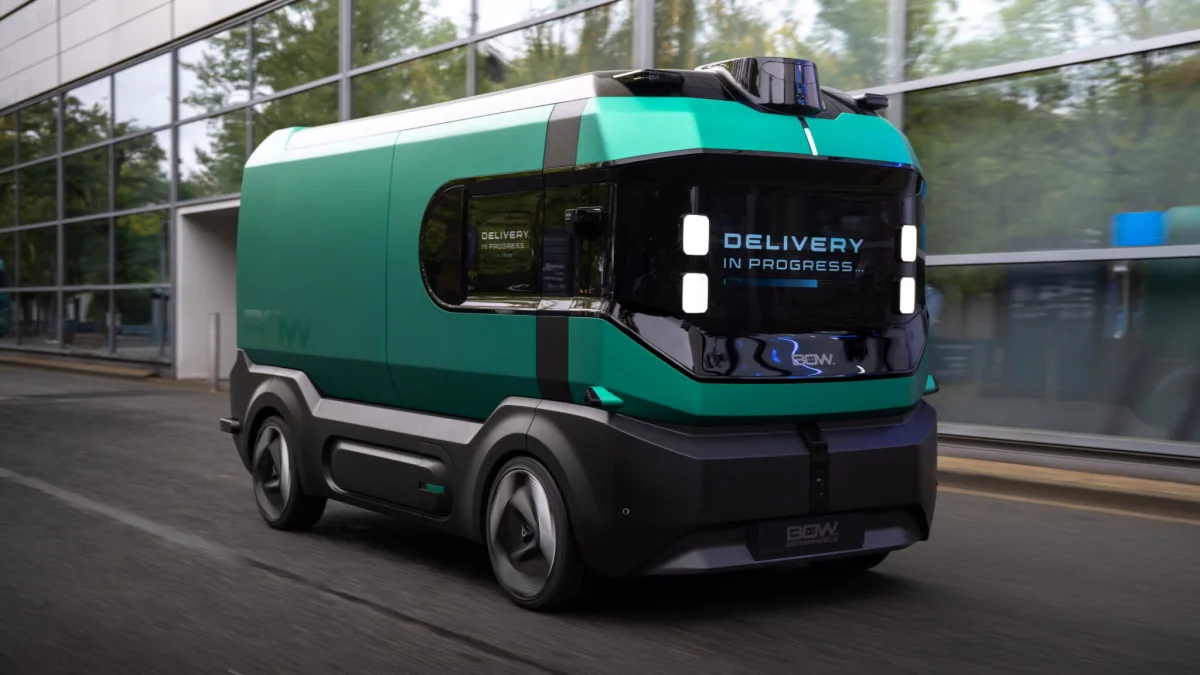
Stellantis has unveiled a fully electric autonomous urban-delivery concept called BOW, which stands for Box On Wheels.
The vehicle has no driver, no cab, no windshield, and no dashboard, reflecting the logic that an autonomous delivery box does not need human controls.
The concept was shown at IAA Transportation in Hanover, Germany, where Stellantis also staged live demonstrations outside its stand.
BOW was developed with China-based UQI Robotics and is intended to explore autonomous logistics in cities, low-emission zones, and controlled spaces such as factories, hospitals, and airports.
Concept Details Remain Unclear
Stellantis is light on specifics for the BOW concept.
There is no battery capacity, range, payload, motor output, sensor list, autonomy level, price, pilot customer, or production target.
The company calls it a concept and says initial validation activities will take place in Europe.
Anything beyond that remains firmly in the “we’ll see” column.
The basic appeal is easy to understand: a conventional delivery van dedicates substantial space to a driver, controls, and machinery required for human operation.
A purpose-built autonomous box could theoretically devote more of that space to cargo while operating as part of a connected fleet.
That is the theory, anyway.
The general idea of a box on wheels delivering goods is already out there and, in small ways, in the wild.
Small sidewalk-based robots currently deliver food and other items in urban environments.
What Stellantis has not unveiled is how it plans to take BOW to public roads.
That said, BOW is important because it gives a glimpse at what to expect from Stellantis in the future.
It does not just plan on selling vans from its portfolio of brands.
Rather, it sees a business where a box on wheels is little more than exactly that, albeit with a lot of software on board rather than a human delivery driver.