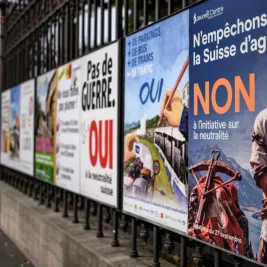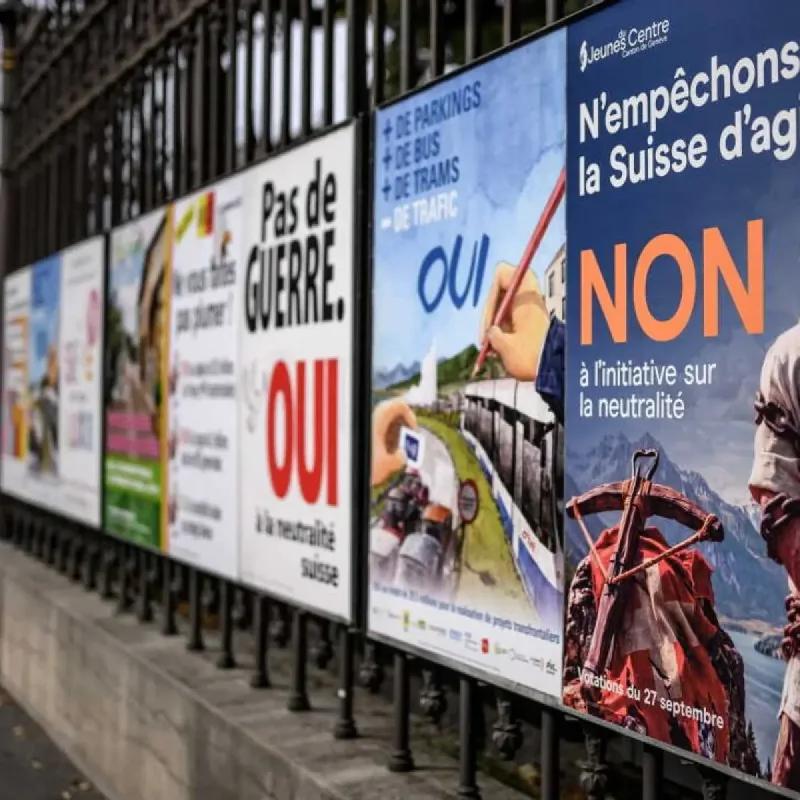
Swiss voters decisively rejected a constitutional referendum to enforce strict neutrality rules on Sunday, September 27, 2026.
Approximately 70% of voters and all 26 cantons voted against the proposal, preserving current foreign policy flexibilities.
The initiative, spearheaded by the right-wing Swiss People's Party (SVP) and backed by pro-sovereignty group Pro Schweiz, sought to define 'perpetual and armed neutrality' in the constitution.
It aimed to prohibit Switzerland from joining military alliances and imposing non-UN mandated sanctions.
Passage of the measure would have restricted the country's ability to mirror European Union sanctions on Russia following the 2022 invasion of Ukraine.
It would have also limited military cooperation with NATO strictly to situations involving imminent military attacks.
Swiss government officials and major political parties campaigned heavily against the measure, arguing it would isolate Switzerland internationally and compromise national security by restricting defense cooperation.
Sibel Arslan, a lawmaker for the Green party, welcomed the referendum outcome.
"Voters understood what the SVP wanted: it wanted Switzerland to isolate itself internationally and shirk its responsibilities when international law is being trampled on," said Sibel Arslan, Lawmaker for the Green Party.
The initiative suffered a major financial loss for billionaire Christoph Blocher, who invested up to 3.8 million Swiss francs to support campaign messaging.
Susanne Vincenz-Stauffacher, a member of the Swiss National Council, criticized the rigid nature of the proposed amendment.
"The initiative would have set neutrality in stone and would no longer have allowed an adequate response to a given situation," said Susanne Vincenz-Stauffacher, Member of the Swiss National Council.
She warned that preventing sanctions against aggressors weakens neutrality.
"At the end of the day you are not neutral but on the aggressor's side," said Susanne Vincenz-Stauffacher, Member of the Swiss National Council.
Other political leaders echoed concerns regarding the proposal's isolating effects.
"Blocher has completely lost his way here," said Marianne Binder, Centre Party Member of the Council of States.
She emphasized that the vote signals Switzerland's commitment to international law.
"Does it mean integration into the military structures of NATO, or does it mean preparations in case of a possible attack?"
said Stephan Rietiker, President of Pro Schweiz.
Following the declaration of results, government officials reaffirmed the country's long-standing foreign policy stance.
"This result is not a vote against neutrality," said Ignazio Cassis, Swiss Foreign Minister.
He emphasized continuity in national defense policy moving forward.
"Switzerland was neutral yesterday, it will be neutral today and it will remain neutral," said Ignazio Cassis, Swiss Foreign Minister.
"Switzerland was neutral, is neutral, and will remain neutral," said Ignazio Cassis, Swiss Foreign Minister.
Voter turnout for the national referendum reached 47 percent.
In a separate national initiative held simultaneously, Swiss voters also rejected a proposal to boost domestic food production by 72.5%.
Franziska Herren, leader of the food security initiative, addressed the outcome after voting concluded.
"we did nothing wrong," said Franziska Herren, Leader of the Food Security Initiative.
She criticized the broad political opposition facing her campaign.
"The public did not want to be deprived of the freedom to choose for themselves what they ate," said Petra Gössi, Representative of the Radical Liberal Party.
The Swiss electorate is scheduled to vote on another defense-related referendum in November regarding the potential easing of weapons export regulations.