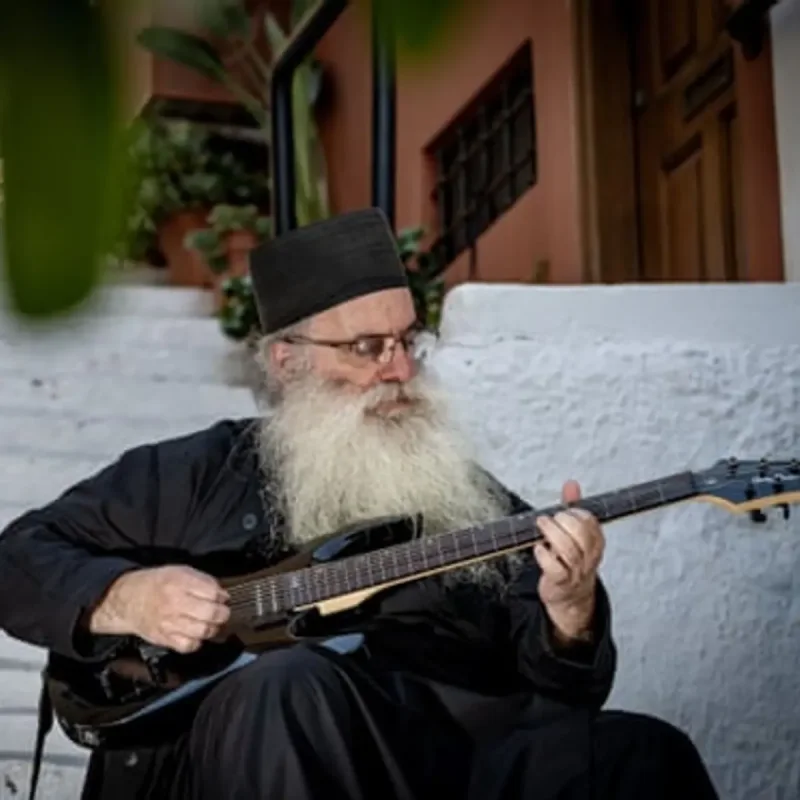
Dressed in long black robes and sporting a fine grey beard, Father Dionysios Tabakis, a 53-year-old ordained priest in the Greek Orthodox church, is orchestrating an unexpected musical revolution from his flat in Nafplio.
Surrounded by musical instruments and religious icons, he challenges centuries of church tradition that deemed secular music satanic.
His favorite instrument is an adapted Harley Benton R-457 electric guitar, bought for €135, which produces wobbly, atonal chords mimicking the human voice.
These distortions feature prominently on Paradise Metal, a home-recorded album blending doom metal, Christmas carols, and religious dubstep.
The project earned a critics' score of 7.6 from Pitchfork, outscoring legendary electronic releases like Aphex Twin's Drukqs and Daft Punk's Discovery.
A DIY Approach to Music
Tabakis grew up in Piraeus in a poor household; his parents attempted to abort him twice, failing because the doctor was out.
He learned Byzantine music from parish priests in middle school and later taught himself obscure instruments like the cümbüş, kabak kemane, yayli tanbur, zurna, and 15 types of ney flutes.
Four years ago, he began recording with a DIY approach: his son taught him production software, a neighbor taught him guitar, and 23-year-old Evgenia Simela Armeni provided vocals recorded on her phone.
Nikolas Rafael, founder of label Elhellell, discovered Tabakis via a Christian forum and was captivated by his unconventional artistry.
"Everyone is a copy of a copy of a copy of a copy," Rafael said.
The album Paradise Metal is a wild sonic journey blending heavy metal, rap, techno, and Byzantine incantations.
The track "Techno in a Monastery" features rhythmic chanting over an ominous synthetic beat.
Tabakis references poet Yiannis Ritsos to explain his philosophy: every instrument is a window to the universe.
Bridging Generations Without Preaching
The album includes tracks like "Flexareis Karga, Ekklisiastiki Rap" and "Dubai Paei," the latter inspired by Middle Eastern conflicts and the vanity of wealth.
Tabakis used rap to bridge the gap between older generations and younger crowds with different slang.
His own children are not highly religious; his 25-year-old daughter is a tattooed photographer in Athens.
When asked how peer priests view his success, Tabakis noted a general silence, hinting at internal church politics.
"They haven't told us, which is a good thing," he said.
He believes God enjoys beautiful things and will never abandon the priesthood for a full-time music career.
"It feels like they've removed a fish from its waters to take it on a walk so it can get some air," he said, describing the idea of leaving his vocation.
Regarding live performances, Tabakis admitted to feeling awkward in the spotlight.