Turkey has reinforced security and transportation measures in Ankara as foreign heads of state arrive for the NATO summit scheduled for Monday and Tuesday, July 6 and 7, 2026.
The capital's Esenboga Airport exempted official diplomatic flights from temporary air traffic restrictions, while alliance leaders emphasized defensive readiness against regional security challenges.
Lithuania Highlights Turkey's Strategic Role
Lithuanian Prime Minister Inga Ruginiene stated that Turkey is an important NATO ally with strong military capabilities and a strategic geographical position.
She added that Lithuania highly values Turkey's solidarity and contribution to the security of the Baltic region.
Ruginiene provided these remarks in written responses to Anadolu before the summit.
She identified Russia as the most direct threat to Euro-Atlantic security, noting that Baltic airspace has faced recent drone incursions from Russia and Belarus.
She expressed hope that the Ankara summit would drive concrete progress toward allocating 5% of gross domestic product to defense expenditures.
Ruginiene emphasized that continued military support for Ukraine remains essential to maintain its momentum on the battlefield.
Defense Spending and Transatlantic Bond
Ruginiene stressed that increasing defense budgets provides new economic and trade opportunities for member states.
She defended the transatlantic bond as the cornerstone of security, noting that while the role of the United States evolves, it cannot be replaced by any other actor.
She warned that viewing the alliance as a separate "European pillar" could be misleading, stressing individual compliance with defense spending targets.
Ruginiene welcomed Europe's renewed commitment to defense preparation following years of insufficient investment, which will boost conventional military capabilities.
Regarding bilateral defense dynamics, Ruginiene reiterated that Turkey's geographic position remains vital for protecting the alliance's eastern flanks against hybrid operations.
Turkey's own defense ecosystem has undergone a massive transformation since the early 2010s under President Recep Tayyip Erdogan, shifting from Western import dependency to international competitiveness.
According to an analysis by General Patrice Moyeuvre reported by Ici Beyrouth, Turkey's domestic program fulfills three strategic objectives: reducing external dependence, asserting itself as a regional power, and providing power projection capabilities.
Ankara's major projects include the MUGEM aircraft carrier, which began construction in January 2025 and is designed to hold 50 aircraft and combat drones, alongside the MILDEN program to build six domestic submarines equipped with Atmaca anti-ship missiles.
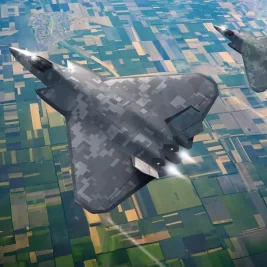
Turkey is also developing the fifth-generation stealth fighter Tf-X KAAN, which completed its maiden flight on February 21, 2024, to replace its aging F-16 fleet.
In August 2025, Erdogan announced the "Steel Dome" project, an artificial intelligence-integrated air defense system.
He described the initiative during its launch as the largest integrated air defense installation in all of Europe.
Turkey's military hardware has gained international renown through deployment in Iraq, Syria, and Libya, driving defense exports from $1.9 billion in 2014 to over $7.4 billion in 2025.
According to the Stockholm International Peace Research Institute, Ankara became the fourth largest arms supplier to sub-Saharan Africa in 2023, exporting drones like the Bayraktar TB-2 to over 25 African nations.
Despite its export success to over 180 countries, including Romania and Hungary, Turkey remains reliant on foreign imports for advanced electronic components and semiconductors.
Moyeuvre evaluated the technological hurdles Turkey still faces in its long-term strategy, noting delays in motorization and very high technologies.