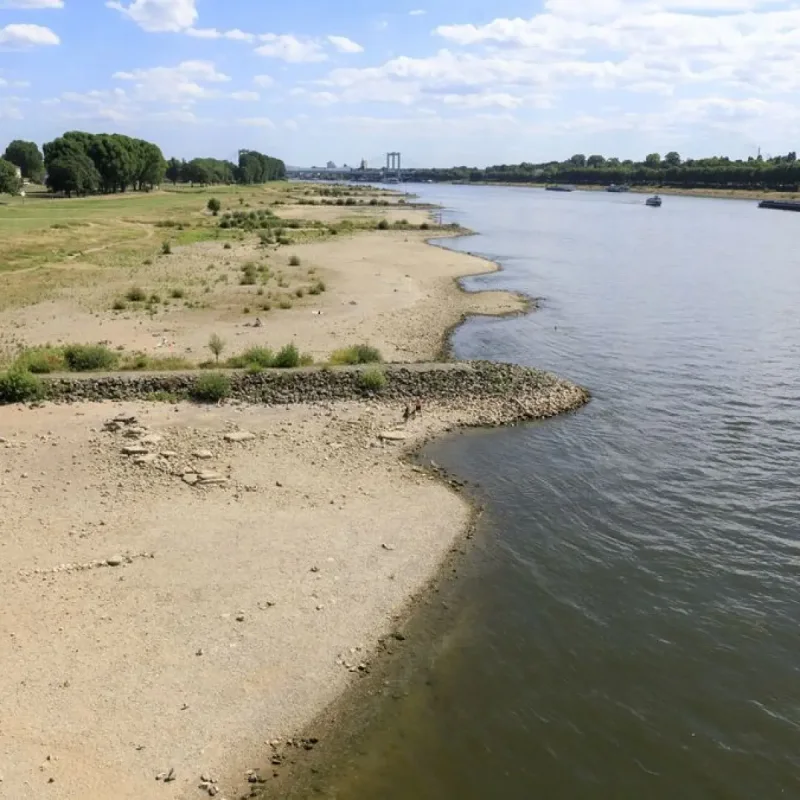
Persistent heatwaves and drought across Germany on Wednesday pushed Rhine River water levels toward historic lows, severely disrupting inland freight transport and threatening to reduce the country's third-quarter economic output by up to 0.2 percentage points.
Temperatures reached 35 degrees Celsius on July 29, 2026, with forecasters projecting peaks of 39 degrees Celsius on Thursday.
Wildfire risks have escalated sharply across southwestern regions, particularly in Baden-Württemberg and near Freiburg im Breisgau.
Water Level at Kaub Bottleneck Drops to 29 Centimeters
Data from the General Directorate for Waterways and Shipping indicates that the water level at the Kaub bottleneck in the Middle Rhine Valley reached 29 centimeters on Wednesday afternoon.
Officials project the navigable channel depth could drop to 20 centimeters by July 31, matching or undercutting the historic minimum recorded in October 2018.
The dropping water levels force cargo ships to operate with only a fraction of their normal load capacity to avoid grounding, requiring companies to deploy additional vessels to haul the same volume of essential goods such as grain, coal, and petroleum products.
"Due to low water levels, vessels cannot carry full loads, meaning maximum capacity is no longer maintained.
To transport the same amount of goods, it is necessary to use a larger number of ships with smaller loads.
This makes shipping operations more expensive and complex," said Marcus Erdmann, Director of Maritime and Waterway Transport at the German Federal Waterways and Shipping Administration.
The environmental impact extends beyond commercial shipping routes to regional bodies of water.
Lake Constance has fallen more than a meter below its multi-year average, leaving several sailboats stranded on mudflats and limiting port access.
In response, local authorities in the Suedliche Weinstrasse district of Rhineland-Palatinate instructed residents to halt water extraction from streams, lakes, and ponds to protect aquatic ecosystems suffering from high temperatures and low flow.