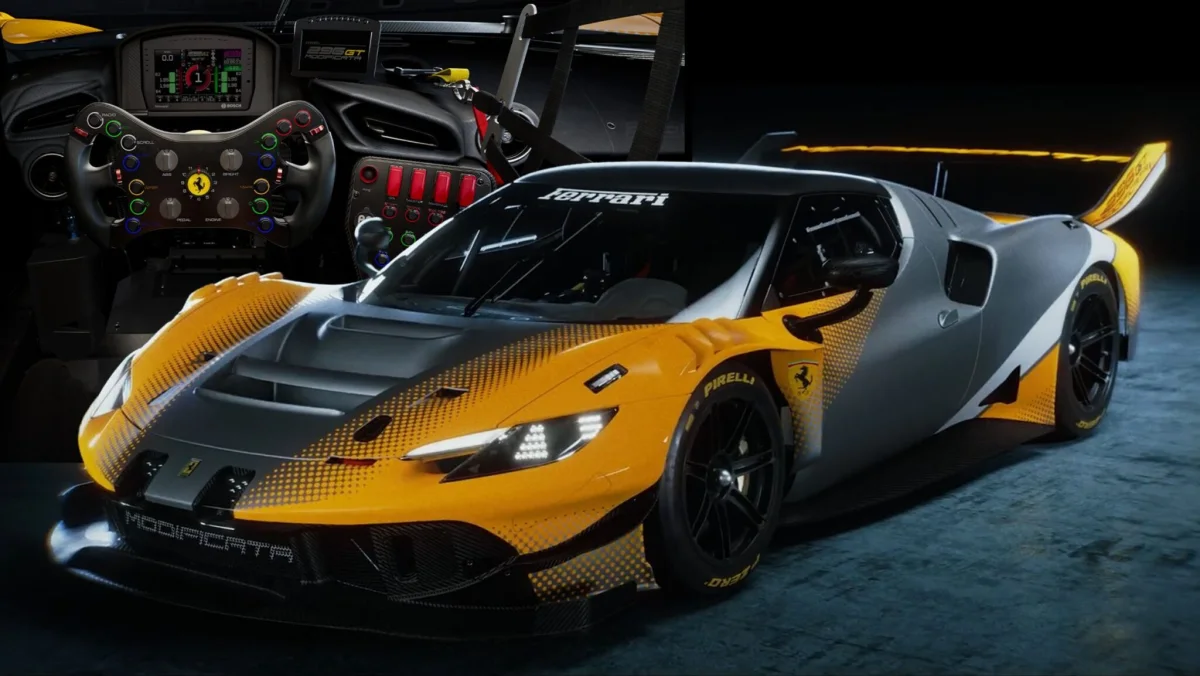
The cabin also includes an intercom system, safety nets, special controls on the yoke steering wheel and center console, a digital instrument cluster, an additional telemetry monitor, and loads of exposed carbon fiber.
Options include a rear radar that warns the driver of cars approaching from behind at higher speed.
Powertrain and Performance
At the heart of the 296 GT Modificata is a twin-turbo 3.0-liter V6 engine that does without the hybrid system of the roadgoing 296 GTB and 296 Speciale.
The unit shares its design with the racing engine but has been upgraded further because it does not need to comply with GT3 regulations.
Changes were focused on the cranktrain, camshafts, induction line, intercoolers, turbochargers, fuel system, transmission, and exhaust.
As a result, the V6 generates 720 hp (537 kW / 730 PS) and 800 Nm (590 lb-ft) of torque.
Power is sent to the rear wheels via a six-speed sequential transmission equipped with a carbon clutch and revised gear ratios.
This makes the GT Modificata 128 hp (96 kW / 130 PS) more powerful than the GT3 Evo, although it cannot match the combined output of 868 hp (647 kW / 880 PS) from the electrified setup of the road-legal 296 Speciale.
Still, with a dry weight of 1,330 kg (2,932 lbs), the GT Modificata is 80 kg (176 lbs) lighter than the lightest version of the Speciale.
Furthermore, it gets a much sharper chassis setup and more aggressive aero components tailored for track use.
According to Ferrari, the 296 GT Modificata can lap the Fiorano track three seconds faster than the 296 GT3 Evo.
While the exact figure is unknown, it most likely beats the 1 minute and 19 seconds of the 296 Speciale.
Ferrari has not disclosed pricing for the 296 GT Modificata, but it is not available to everyone.
The track-only supercar is exclusively offered to select clientele of the Club Competizioni GT programme.
Each buyer gains access to two years of competition and track-side support, including 12 rounds at famous circuits around the world.