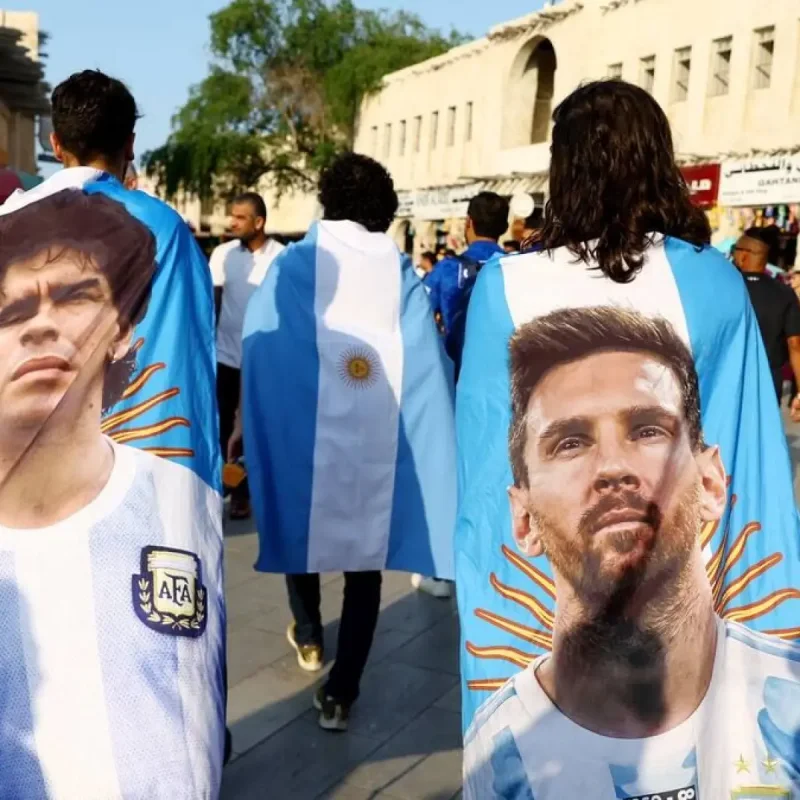
Lionel Messi became the highest goalscorer in World Cup history on June 22, 2026, after scoring twice against Austria in Dallas to reach 18 tournament goals, surpassing German forward Miroslav Klose.
The historic milestone has ignited a profound cultural and athletic debate regarding the contrasting legacies of Messi and Diego Maradona as Argentina competes in the 48-team tournament.
The achievement came exactly 40 years after Maradona scored his historic goals against England in 1986.
While Messi dominates the statistical records, former players and analysts have highlighted deep differences in temperament, team dynamics, and cultural impact between Argentina's two iconic number 10s.
Team Dynamics and Tactical Support
Former Argentine player and manager Pedro Troglio analyzed the current squad's structure, emphasizing how specific players protect their captain on the field.
Troglio noted that striker Lautaro Martínez performs an enormous exhaustion so that Messi receives the ball fresh.
He further explained that the midfield stability allows the team to maintain physical consistency throughout matches without suffering drops in performance.
Troglio described Enzo Fernández as contributing dynamics, fluidity, and arrival into the box from the midfield.
He also praised the defensive partnership of Cristian Romero and Lisandro Martínez for consolidating a solid defense that gives total tranquility to the team.
Contrasting Personalities
The contrast extends to personal interactions on and off the pitch, highlighted by historical moments where Maradona fiercely protected his players, unlike Messi's reserved nature.
During the 2010 World Cup, Maradona shouted at a Greek player from the dugout after he confronted Messi.
Maradona was known for his combative public persona and confrontational remarks toward critics throughout his turbulent career.
His registered trademark phrase "You have it inside" expressed defiance against his detractors.
Reflecting on the milestone, Messi maintained a modest perspective on his newly acquired position at the top of the global football hierarchy.
"It is an honor to be alongside Klose, of (Nazario) Ronaldo, of (Kylian) Mbappé. Ronaldo is one of the greatest and he is not first.
In the end, everything is pure statistics," said Messi.
Journalist Marcial Ferrelli noted that football holds a unique place in Argentine society, serving as a reflection of its internal cultural contradictions.
"Unlike politics, football offers a passionate and cyclical resolution based on faith and the game, beyond adverse results.
Football happens twice: once on the pitch and once in the mind of the public," Ferrelli wrote.
The date of Messi's record-breaking performance directly links his modern success to the folklore established by Maradona four decades prior.
"The hand of God" remains one of the most famous phrases associated with Maradona's first goal against England in 1986.
His second goal in that match is widely celebrated as a pinnacle of individual skill in sports history, known as "The goal of the century."
Commentators note that the public often attempts to merge the distinct virtues of both players into a single idealized figure.
Political commentator Diego Brancatelli stated that both must be celebrated together footballing-wise.
However, sports analysts emphasize that the two athletes represent completely opposite value systems and models of leadership for the nation.
ESPN journalist Federico Bulos observed: "Messi is the Argentine we would like to be. Maradona, on the other hand, is the Argentine we are."
Writer Gonzalo Sarasqueta noted that society often forces a binary choice between the two icons due to an addiction to melodrama.
"I divide, therefore I exist" is the cultural mantra that drives these constant comparisons, according to Sarasqueta.
To illustrate the collective mindset during major national events, Sarasqueta cited an anecdote from author Fogwill during the Malvinas War.
Fogwill's mother shouted "We sank a ship!"
while listening to the radio during the conflict, and the author immediately recorded the moment to capture how individuals internalize national events from afar.
"Mom sank a ship," Fogwill noted on his paper, highlighting the gregarious consciousness shared during football matches and wars.
Ultimately, experts warn against letting the weight of past achievements overshadow the daily reality of modern competition.
Editor Benjamin Bradlee reminded his journalists: "Do you realize? Then, the only thing that counts is the story of the day.
Of each day. Go back to work."