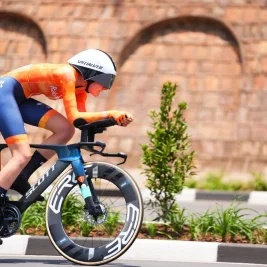
"We had that approach loop, which was also neutralized. The pace behind the car kept going from 30 km/h to 40 km/h and back.
>>> Three Firefighters Killed Battling Wildfires on Colorado-Utah Border
And then we got here, on the first climb, and they ride neutralized at 45 km/h through that village," Artz said.
The 24-year-old rider criticized the positioning behavior of younger riders in the peloton.
He specifically pointed out dangerous maneuvers by under-23 athletes fighting for position among the professionals.
"It was also slippery from the rain this morning," Artz said.
Artz argued that the 170-kilometer course was naturally selective enough to separate the contenders without requiring high-risk positioning so early in the race.
"There were also guys who see opportunities here, among the pros.
I mean especially the under-23 riders, sometimes it's just really dangerous how they position themselves or come underneath," Artz said.
According to Artz, the size of the starting peloton was fundamentally too large for the narrow 10.7-kilometer local circuit, which caused the field to shatter immediately.
"I'm not going to name names, but yes, they don't really think about the fact that it's almost 170 kilometers of racing.
And that the course is selective enough that you'll eventually rise to the top," Artz said.
Only 22 riders officially completed the full distance. Artz and his group were pulled ahead of the final lap where the under-23 sprint took place.
Artz concluded that a longer lap format would have been more appropriate for the national championship given the large size and mixed quality of the field.
"I think it's just too big a peloton for such a lap.
You also see that it actually falls apart right from the start and that only 40 riders are in the race," Artz said.
>>> US military justice on overseas bases: Host nations question fairness
The elite men's road title was ultimately won by Wilco Kelderman of Visma-Lease a Bike. He secured his victory ahead of Bauke Mollema and Jochem Kerckhaert.