A pair of powerful earthquakes measuring 7.2 and 7.5 magnitude struck northern Venezuela within a minute of each other on Wednesday evening, killing at least 1,430 people and flattening hundreds of structures.
A third quake of magnitude 4.8 hit near northern Aragua state on Saturday afternoon as emergency personnel race against time to pull survivors from the debris.
Severe Destruction and Casualties
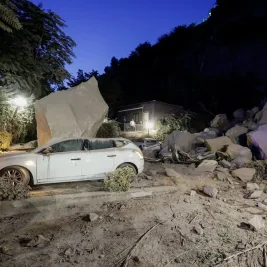
National Assembly President Jorge Rodriguez reported the updated figures on state television, confirming severe destruction in the coastal state of La Guaira and sections of nearby Caracas.
The disasters also injured 3,200 individuals, left 3,100 people homeless, and left between 50,000 and 70,000 citizens unaccounted for by their families according to diverse agency estimates.
The United Nations Development Programme reported on Saturday that preliminary assessments show $6.7 billion in asset losses, representing 6 percent of Venezuela's gross domestic product.
Acting President Delcy Rodriguez deployed over 14,000 police and military personnel to secure affected areas while approximately 1,600 foreign specialists from countries like Mexico, the United States, Spain, and Brazil arrived to support local workers.
"Every person saved is a miracle," said Jorge Rodríguez, president of the country's National Assembly.
He emphasized that the administration would maintain transparency regarding the disaster. "We will not hide anything about the scale of this tragedy," said Jorge Rodríguez.
Infrastructure Failures and Desperate Searches
Civilians in several coastal towns have experienced severe infrastructure failures, including widespread mobile and internet service outages.
In Catia La Mar, families are attempting to clear rubble manually while waiting for heavy machinery to safely access collapsed structures.
"There's no information at all.
People who know him say they didn't see him come out or anything," said Jesús Suárez, a resident who traveled 200 kilometers to search for his son Jean.
"I believe he might be in there," Suárez said, pointing toward the heavy debris that remains dangerous for civilian volunteers to move independently.
"It's impossible to rescue him... There is no sophisticated equipment here.
A human being alone cannot do it - it's too dangerous," he added.
In adjacent neighborhoods, residents reported detecting odors from the casualties trapped beneath buildings, expressing concern over potential health complications for local children.
Government food aid has reached some sectors, supplemented by support from Caracas volunteers.
"There's a smell… the dead are already being felt. That's going to make us and the children sick," said Glendys Delgado, a resident.
Local families are utilizing personal drones to survey unreachable debris fields for signs of missing relatives.
The local airport in Maiquetía has served as an open-air refuge for displaced residents whose homes remain highly unstable.
"The children started screaming.
We didn't understand what was happening, and suddenly the building next door collapsed and my husband reversed the car," said Alexandra Gabino, a resident.
Gabino and her family are currently living out of their vehicle in the airport parking lot while her husband attempts to retrieve vital records from their damaged 15th-floor apartment.
"The essentials," she said.
International Response
Officials from the United States State Department confirmed that the American military is coordinating humanitarian logistics, deploying two 80-person teams and an offshore transport vessel to assist with emergency medical evacuations.
"People are trapped under rubble, and the priority is to get the search and rescue teams and the medical professionals and others to them as quickly as possible to save lives," said Jeremy Lewin, US State Department official.
Lewin described the current operational phase as a direct race against the clock to locate injured citizens before survival windows close.
"People are still terrified to re-enter what were their homes," said Loyce Pace, International Red Cross regional director for the Americas.
The deceased include multiple foreign nationals, with official logs recording casualties from Portugal, China, Spain, Brazil, and Italy.