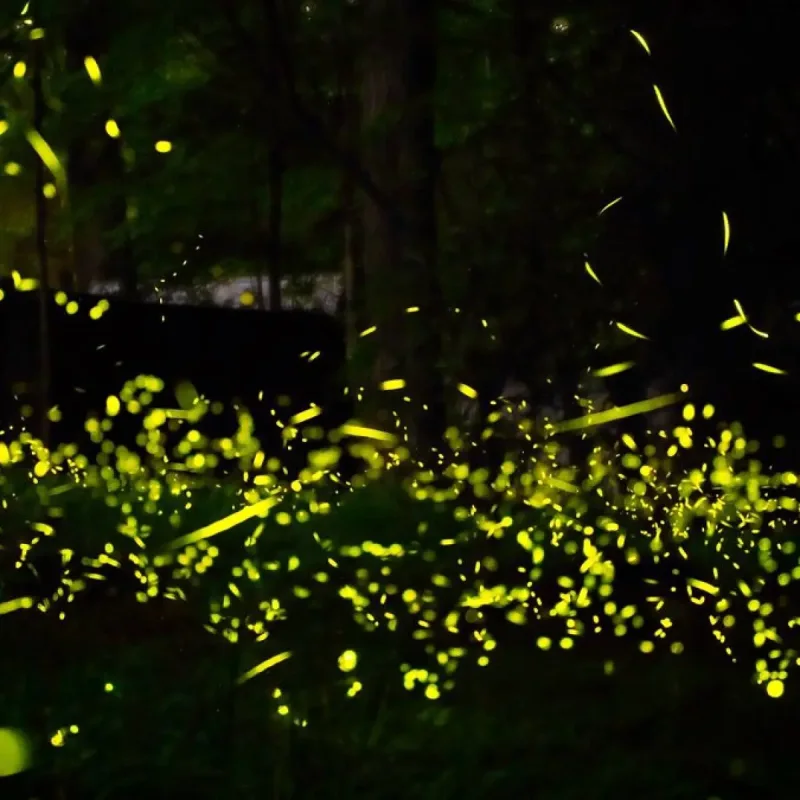
An optimal combination of consistent spring moisture and exceptionally warm temperatures has triggered one of the most active and brilliant summer firefly displays across portions of the United States, according to entomologists and meteorologists.
The massive seasonal outbreak stems from weather conditions that began months ago, keeping soil damp for underground larvae and accelerating their life cycle in states like Missouri and Ohio.
National parks across the country, including Shenandoah, Congaree, Cuyahoga Valley, Mammoth Cave, and Indiana Dunes, are currently experiencing peak viewing opportunities due to their protected habitats and minimal light pollution.
How Fireflies Produce Light
Clyde Sorenson, a professor of entomology at North Carolina State University, spent many years studying these bioluminescent beetles, which naturally produce light through a distinct chemical reaction inside their lower abdomen.
"I noticed that I had a pretty significant diversity of fireflies in my own yard," says Sorenson, "so I started trying to understand that diversity."
Sorenson noted that the bugs contain a special organic compound called luciferin that combines with oxygen and an enzyme known as luciferase to create a biochemical reaction producing yellow, green, or rare blue light.
"It's the species that's typically active when lots of folks are still out poking around," says Sorenson regarding Photinus pyralis, the common eastern firefly or big dipper firefly.
The insects are cold-blooded, requiring surrounding temperatures in the upper 70s and 80s to fast-track their metabolism and cause them to flash rapidly, while high humidity keeps their chemical pheromones close by.
"It depends on what life stage you're talking about," says Sorenson explaining why fireflies illuminate.
Larvae flash as an aposematic defense signal to warn potential predators that they taste bad due to toxic steroids called lucibufagins, while adults use specific flashing patterns to communicate and attract mates.
"Their bright glow signals to others that they taste bad," says Sorenson.
Over tens of millions of years, adult insects adapted this light-producing ability into intricate mating rituals where flying males signal females waiting in vegetation, who then flash back if interested.
"In most North American fireflies, the males have a specific flash pattern," says Sorenson.
While call-and-response systems are common, each species uses a unique pattern, such as the synchronous species in Great Smoky Mountains National Park and South Carolina's Congaree National Park that coordinate vast displays of synchronized light.
"If they fly around at the right time of night, and make the right signal, a female might see the signal and flash back at him," says Sorenson.
However, predatory "femme fatale" fireflies of the genus Photuris mimic the flashing patterns of other species to lure in males and eat them, absorbing their glowing toxins to protect their own eggs.
"Then if everybody's happy they mate, and nobody flashes anything for a while," says Sorenson.
Sorenson explained that adult fireflies do not produce lucibufagins naturally, making this deceptive hunting strategy essential for acquiring protective chemical defenses from their prey.
"If you're familiar with the various flash-patterns, you can figure out the species," says Sorenson, noting that roughly a quarter of world species are dark as adults.
Most fireflies complete the bulk of their feeding during their one to two years as underground larvae, consuming soft-bodied insects like snails and slugs before undergoing metamorphosis into adults.
"The femme fatales then use those [glowing] chemicals to protect their eggs," says Sorenson, "and to some extent to protect themselves from predators."
Mature fireflies live for only five days to a month, dedicated entirely to mating and reproduction, while displaying a nearly 100 percent efficiency rate in converting chemical energy into light.
"As adults, their main job is to find each other and mate and make sure there are more fireflies for next year," says Sorenson.
Despite the current boom, long-term firefly populations face steep declines due to habitat loss from urban sprawl, agricultural chemicals, and artificial light pollution that disrupts their critical bioluminescent mating signals.