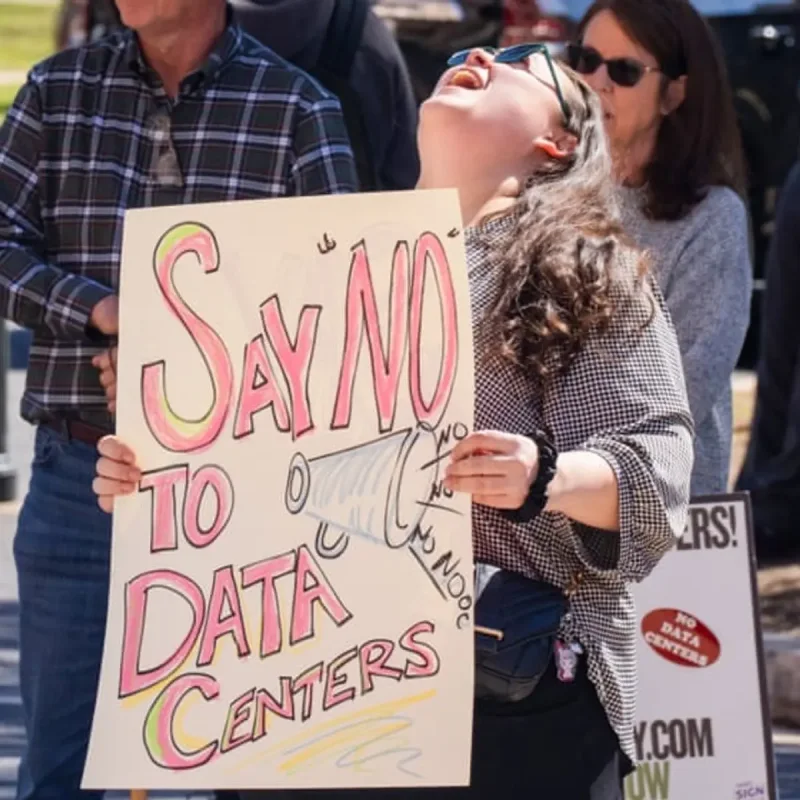
Residents across the United States are increasingly pushing back against secretive data center projects, with bipartisan coalitions forming to demand transparency and halt developments they say threaten local resources.
In Lenox Township, Michigan, a website promoting a proposed data center campus went live in May without disclosing the developer.
Township officials denied any application, but emails obtained by residents revealed that developers had contacted local leaders for support.
The perceived secrecy sparked outrage, leading to packed public meetings and a petition to recall four members of the Lenox board of trustees.
“The community still has questions that aren’t being answered,” a resident said.
Growing Opposition Across Party Lines
The movement is notable for uniting Republicans and Democrats, a rare phenomenon in today’s political climate.
“It reflects the growing anxiety about AI writ large,” said Evan Sutton, a strategist.
Data centers consume enormous amounts of electricity and water.
A typical facility uses 300,000 gallons of water daily, while large ones can use 5 million gallons per day, straining local supplies and grids.
During the first quarter of 2026, at least 75 data center projects worth about $130 billion were blocked or delayed, according to Data Center Watch.
In May and June alone, recall efforts were launched in states including California, Florida, Michigan, Missouri, Oklahoma, Oregon, and Texas.
Recall Efforts Escalate
In Festus, Missouri, residents filed a petition to recall the mayor and three council members after they approved a $6 billion data center agreement with CRG Clayco.
The developer had previously faced opposition in St. Charles, where voters banned data centers.
“The company usually goes public only after the decisive votes have been taken,” said Michael Bommarito, author of “How to Fight a Data Center.”
Despite a judge validating the recall petition, the city council rejected it, prompting a legal challenge.
In Yukon, Oklahoma, Republican Joe Horn filed a recall petition against the mayor and vice-mayor over a proposed $1 billion data center.
“We already ration water here in Yukon,” Horn said. The vice-mayor resigned, and nearby Luther passed a six-month moratorium.
Supporters of data centers argue they bring economic benefits.
Vice-Mayor Jeff Wootton of Yukon said the intent was never to conceal information but to protect sensitive negotiations.
Meanwhile, some have alleged without evidence that China is driving opposition.
Kevin O’Leary, a Shark Tank star, made such claims on Fox News but later admitted he had no proof.
Fox News issued apologies for airing his statements.
In Lenox Township, the campaign website was linked to a political advocacy firm, but the effort appears to have stalled.
The site now states: “This campaign has ended and is no longer taking action.”